
Plainfield Previous Residents by Era
There is no one record that lists every past household at a Plainfield Township address. The reliable approach separates the parcel trail from the household trail. The county property and map systems establish a current parcel and address context. Recorded instruments help trace transfers. Regional directory collections, map materials, cemetery records, newspapers, and archives add dated clues about people and place. Each source has a different time window and purpose, so an entry should be cited as what it is rather than promoted into proof of residence.
| Source | Years It Covers | Where Held | What It Shows |
|---|---|---|---|
| Kent Property Search and GIS | Current assessment cycle and current map view | Kent County online portals; local assessor for questions | Parcel identifier, property-address context, and owner or taxpayer fields |
| Kent Register of Deeds online index | January 1, 1970 forward | Kent County deed portal | Recorded-instrument index and links to the document access route |
| Register of Deeds office and historical repositories | Earlier records and material outside the online index | Register of Deeds, archives, and historical repositories | Older recorded-document research and copy-request follow-up |
| Grand Rapids and Kent County directory holdings | 1856-present reported for the regional collection | Grand Rapids Public Library | Dated name, address, business, and household clues where an edition includes them |
| Kent County plat-map material | 1855-2007 physical; 1855-1921 digital material reported | GRPL House History research route | Geographic and legal-description context for an older place |
Begin with the era you can document. For a Plainfield Township property, a post-1970 transfer may be quickest in the online deed index. Earlier work often starts with the same parcel number or legal description, then moves to the office, library, archive, or historical repository named for the record. A directory date can come before a deed image in a research file, but it remains a dated listing rather than a substitute for the instrument. This distinction is central to a Plainfield Township previous residents trail.
Plainfield Parcel Before the Name
Work from the property outward. Kent County Property Search accepts a street number or range, street name, and city, township, or village selection. Its municipal list includes Plainfield Township. A Plainfield Township property can be tied to the current parcel before a historical name is considered. The search tips advise trying a direction prefix both with and without it, omitting punctuation and street descriptors, leaving off a direction suffix, and trying both numeric and alphabetic forms for numbered streets. Record the parcel number and assessment year with every result.
The portal combines Treasurer and Equalization data and says values are current as of March, with later changes processed in the annual cycle. It does not offer a direct owner-name search in the reviewed interface. The Kent County Public Viewer can add parcel geometry, property address, and owner or taxpayer field context. Neither field is automatically a deeded-owner conclusion. For an assessment or tax-map question, contact the Plainfield Township assessor or Kent Property Description and Mapping; for a recorded transfer, use the Register of Deeds.
Kent Deed Chain for Plainfield Previous Residents
Ownership evidence is traced through the recorded chain of title. For a Plainfield Township address, the Kent online deeds notice says the index begins January 1, 1970 and that searching is free. Search results are a finding aid. The portal warns that the underlying document controls, much like a library catalog points to a book rather than replacing it. Match the legal description and the parties carefully before advancing to the next transfer.
- Use the current parcel record to retain the parcel number, property address, and legal description.
- Locate the most recent relevant recorded instrument through the deed index and record its date, parties, and recording reference.
- Read the person who conveyed the property as the earlier link, then locate that person's prior acquisition where the legal description matches.
- Repeat the comparison backward, keeping a separate note for name changes, parcels that split or combine, and incomplete index results.
- When the trail reaches material before the online baseline, ask the Register of Deeds or an archival repository about the next access channel instead of assuming the chain ends.
- Grantor
- The party conveying an interest in the recorded instrument.
- Grantee
- The party receiving the interest identified by the recorded instrument.
- Chain of title
- The sequence of recorded transfers tied to the same property interest and legal description.
- Legal description
- The land description used in a recorded document. It is often more durable than an older mailing address.
Note: For Plainfield Township research, a taxpayer name, directory line, or map label can help locate a document, but the recorded instrument is the source for the transfer it describes.
Plainfield Previous Residents and the 1970 Index
The 1970 online baseline is an access boundary, not a history boundary. A Plainfield Township search still needs the legal description and recording context. Kent's June 22, 2026 notice separates free searching from image access: basic printed or downloaded images cost $1 per page, while advanced access is listed at $25 for 24 hours or $2,000 for one year, plus a small convenience or handling fee. Those terms are dated and should be checked again before payment. The deed-search portal is the official starting point for the index and its current disclaimer.
The official deed-search screen shows the first access step for a Plainfield Township previous-residents deed trail.
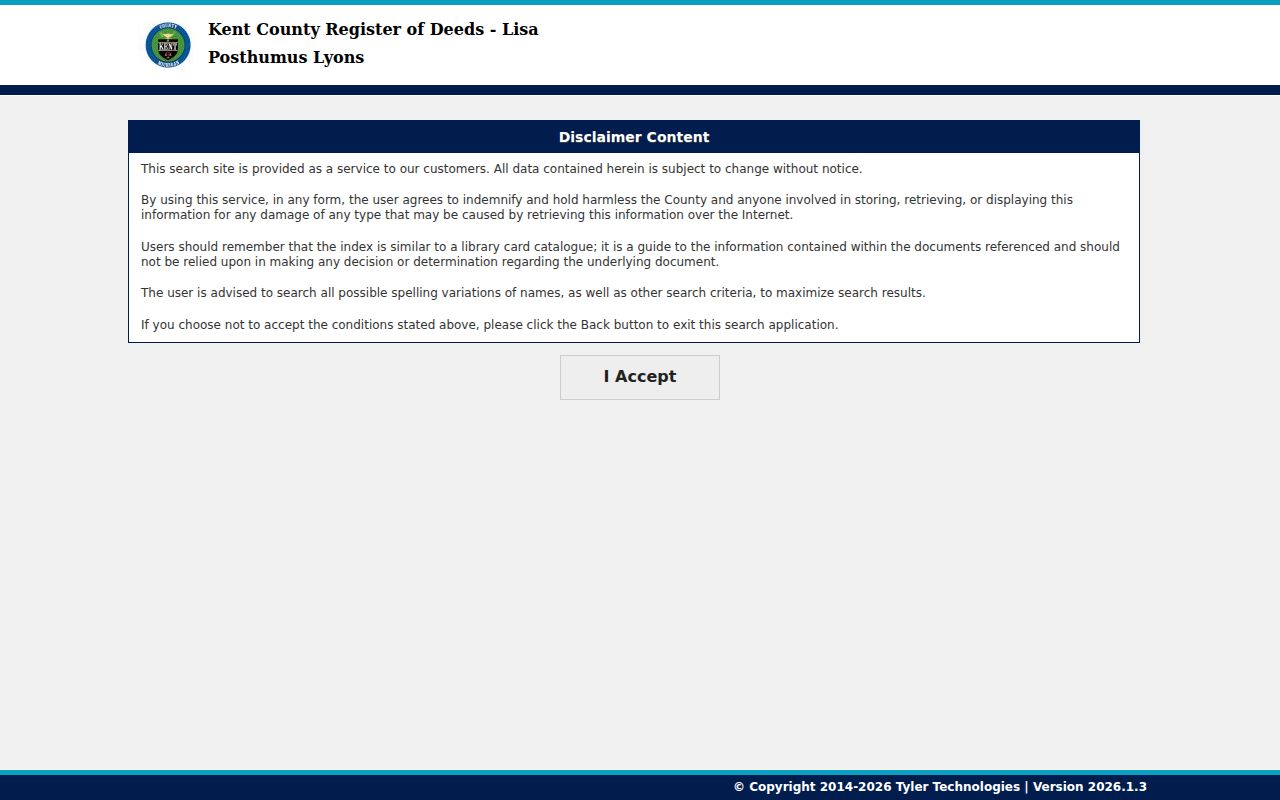
The image supports a Plainfield Township index-search route. It is not a deed image, a title opinion, or a declaration that a listed party lived at the property during the full period.
The Register of Deeds records deeds, mortgages, land contracts, liens, and other real-property instruments. Its office guidance says copies can be requested in person or in writing with recording information. A Plainfield Township record should retain the parcel and legal-description bridge with that request. Fees apply to recorded instruments and certified copies, but the reviewed page did not establish a current exact copy fee. Keep the index result, access date, and document status together.
Plainfield Documents Before the Online Index
When a likely Plainfield Township transfer predates the online index, shift from a portal search to a custodian-and-repository request. The Register of Deeds is the first office for earlier recorded instruments. The county says written copy requests should include recording information. The office or historical repositories are the documented follow-up for material outside the online window. A visit, a written request, or a staff question can be more productive than repeated searches with an address that did not yet exist in its present form.
The Archives of Michigan county-guide gateway and its Kent guide are useful for locating series by agency, municipality, date range, and record type. Archives staff caution that records are rarely organized by name and may need onsite retrieval. The Historical Society of Kent County research library adds manuscripts, ledgers, maps, genealogies, cemetery records, photographs, and oral histories. Ask with a Plainfield Township name, the relevant postal locality, a date range, and a parcel or street reference.
The Historical Society reports that appointments depend on staffing, research can take several weeks, and cataloging continues. A no-result catalog search may mean not cataloged or not accessible, not that the record never existed.
Past Households: Directories, Census, and Obituaries
Owners are only one part of a Plainfield Township house history. The regional directory collection may place a name, business, telephone listing, or address in a specific publication year. Compare it with the relevant released census schedule, then test the proposed household through an obituary, cemetery entry, vital event, probate record, or deed. The point is to see whether independently created records agree on the same date and place, not to make a name-only match do all the work.
- Locate the address or surname in the nearest available regional directory and save the edition, page, and postal label.
- Search adjoining directory years for moves, initials, married names, or a changed street form.
- Compare the dated listing with the relevant released census schedule without assuming every person at the address was printed in the directory.
- Use an obituary, cemetery result, probate record, or vital record to test an event date and family relationship.
- Return to the parcel and deed trail when the household clue suggests a transfer, split, or earlier legal description.
The collections and entry-reading method are described in the Plainfield Township Directory Book. GRPL's House History research route also identifies real-estate listing cards from the 1950s through the 1990s, Kent County plat maps, Sanborn maps, appraisal cards, and aerial material. It cautions that records for a property outside Grand Rapids may need to come from the local township office.
The House History source illustrates a way to combine Plainfield Township previous-residents clues with maps, directories, and property records.
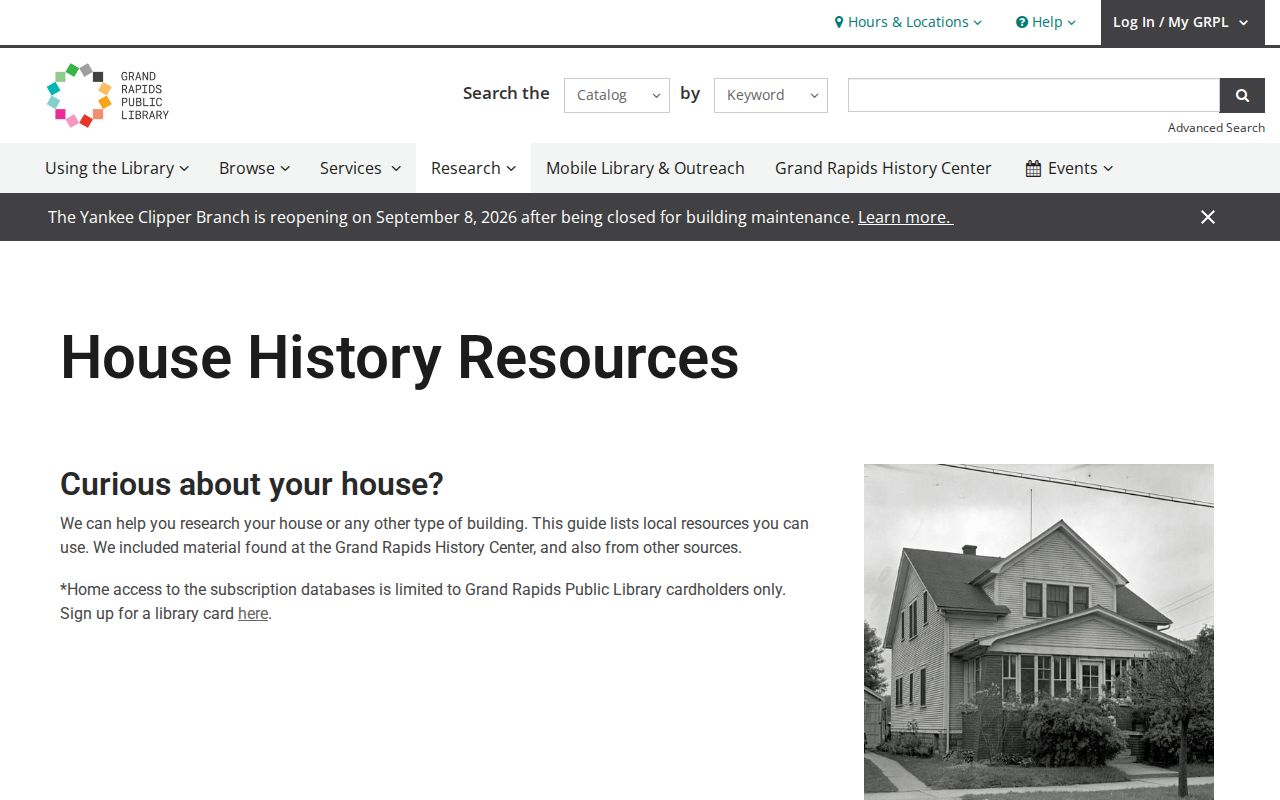
Use its source map to identify the next record type to request. A Plainfield Township researcher should still verify the township custodian. The listed Grand Rapids appraisal-card range is not a promise that the same material covers a Plainfield Township parcel.
Plainfield Previous Residents Across Mailing Names
Plainfield Township addresses can use Belmont, Comstock Park, Grand Rapids, or Rockford postal localities. A historical directory, census entry, obituary, or deed can therefore seem to move a family when the political jurisdiction stayed the same. Keep the county, township, postal city, street range, parcel, and date separate. The Plainfield Township designation should remain visible in the research note. The Kent County street directory offers a local geographic bridge, and the property and GIS systems can connect a current parcel to that broader setting.
The same caution applies to old address changes. GRPL's 1912 warning concerns Grand Rapids city addresses, not a documented Plainfield Township conversion. Where an older number does not fit, use the legal description, plat, road, adjacent parcels, and postal locality to test the bridge. Preserving uncertainty is better than attaching a family to a compelling but wrong address.
Note: A mailing city identifies delivery context, while the township and parcel establish the local jurisdiction used for the property trail.
Plainfield Previous Residents, Burial, and Privacy
Deaths and burials can close a family-history question without proving a person's last residence. Plainfield Township Cemetery and Oakwood Cemetery are administered through the township clerk, and the township's cemetery page directs historical searches to a separate cemetery-finder application. A death certificate, finder result, obituary, and directory year are separate time-stamped clues. They become stronger when names, dates, and place context agree.
Michigan's public-record boundaries still apply. Voter records withhold several personal fields, and the Michigan Address Confidentiality Program provides a substitute address for eligible participants. Do not attempt to identify or expose an ACP participant's physical address. A missing result may reflect a protected record, a gap in the source, or a mismatch rather than an invitation to search around the boundary.
Lawful use. Plainfield Township previous-residents research is appropriate for family history, estate or heir questions, and property history. Do not use a past address trail to stalk, harass, track, or harm a living person.